
Welcome

Established in 1991, the FES Center is a consortium with three institutional partners: Cleveland VA Medical Center (CVAMC), the private educational institution of Case Western Reserve University (CWRU), and the public hospital system of MetroHealth Medical Center (MHMC). Read more...


Follow the journey of Jen French, Cleveland FES Center research participant, in her "Stand by Me" journal. Jen participates in the Stand & Transfer Program for Spinal Cord Injury and will receive an upgraded FES system for trunk control and stand/transfer.

This site will contain journal entries from Jen during her pre-surgical preparation, surgery, recovery and rehabilitation with intermittent comments from the clinical team clarifying Jen's progress and experience.

Although this site is hosted by the Cleveland FES Center, Jen's Journal is her own.

Jen's journey begins...


Closing of a Chapter, a Year to a Close, Last Entry

September 23, 2011

Reflecting on the progress over the passed 14 months, I’m amazed at how far we have come. In August 2010, a medical device was implanted into my body. Over the passed year, the system has been tested, tweaked and programmed. Along the way, I’ve gained a free back massage, an easier way to propel my wheelchair and the ability to stand and transfer for functional uses.

There have been countless hours in the lab and numerous email exchanges. In this journal, I’ve mentioned the scientists, the surgeons, the engineers and the therapists. But the reality is that there is an army of people working on developing this device. They are the ones that we don’t see like programmers in the technical lab, developers tweaking the equipment, students testing the experimental design, the nurses giving exceptional care and administrators managing the array of paperwork. They have ownership in this system just as much as those on the front lines who work with the participants.

There are also the hidden heroes. I’ve been fortunate to have an incredible support network. My husband, Tim, has sacrificed so much to help me from surgery recovery to functional use. He has become harder on me than the therapist, but I love it. My in-laws, who are loyal cat-sitters and help with the cleaning while I’m away. My sister and her family have hosted me in their home for the many visits to Cleveland with the countless meals and scheduling arrangements. This journal wouldn’t be complete without recognizing my Mom. What a trooper; meeting me at the airport in wee-hours of the morning, driving me between hospitals and laboratories, waiting while I have meetings and tests and pitching in when the research team needs a hand. And the cookies! The research team will forever be spoiled by my mom’s cookies. Over the course of time, she has become a member of the research team. She is a true hidden hero.

Of course, money makes the world work. The research project would not be possible without the funding agencies and institutions that believed in the concept and support this research team. Case Western Reserve University, MetroHealth Medical Center, National Institutes of Neurological Disorders and Stroke of the NIH and the Veterans Administration Rehabilitation Research and Development Service. Yes, this project is partially funded by the VA. Although, I am not a veteran, being participant is one way that I can give back to our wounded warriors living with spinal cord injuries. One day, they will benefit from the discoveries of this research.

As I reflect on this experience, it is so easy to get used to the technology and integrate it into your daily routine. After a while there is never a second thought about turning on the system for a pressure relief, pressing a button to get trunk control or having the option to stand and transfer. When I take the coils off and put the UECU on the charger, I’m reminded of the way I was left after the spinal cord injury, minus all these new bionic functions. It is a reminder to appreciate the technology.

This experience was not just a discovery of the technology but also a discovery of myself. I learned to appreciate the power of music and images catering to the importance of mental preparation. Quoting many lyrics to songs sometimes define an experience and help to describe it eloquently. The images taped to the walls of my hospital room to help overcome the post-surgical pain are now staples of the Clinical Research Unit.

I’ve learned patience for others and for myself. The time waiting to properly set-up an experiment or the time to allow the body to properly heal resonated the power of patience. The hours of repeated experiments to achieve reliability scream to find ways to keep the team (and me) entertained.

I’ve learned the process of experimentation is never straight-forward and the value of flexibility to re-design to get the best outcome is a necessity in research. I can appreciate the discovery in success but also the discovery in failure; each being a critical part of research, and any growing experience for that matter.

Even after the ‘Wow!’ factor from the initial stand has worn thin, I find that I’ve grow more demanding on the system. I expect it to work every time the system is booted up. And, it does. Daily use transforms from a nice option to a necessity in life as a quadriplegic living independently.

Music has become intertwined in this experience. Every time I draft a journal entry, themed music is in the periphery. As I’m writing this final entry, these lyrics are resonating in my ears: “This is a call to the color blind. This is an I.O.U…cause I’m bigger than my body gives me credit for…” (John Mayer) What a great way to sum up this experience. The research is more than my ability to stand using my own muscles. It is functional recovery after a spinal cord injury, even for people like me who are 10+ years post injury.

Finally, this journal can’t be closed without thanking all the readers and followers of this journey. The messages of encouragement, gracious cheers and heart-felt notes have helped me along the way. I am still amazed at even the silent readers. I hope this has helped to build an understanding of the human experience and the required commitments of clinical trials. I am not the only one to participate in the exciting world of scientific development, nor will I be the last. This is one small contribution to the evolution of technology and the progress to improve life for people living with spinal cord injury.

Thank you for the experience.


Getting Ready for Release

September 8, 2011

The test protocols are coming to a close and soon I will be released from the program. What does getting released mean?

Getting released from a clinical trial involving an implanted device is bit unique.  For a pharmaceutical (drug) trial, you just stop taking the medication, take a few surveys and then you go on your merry way. (I’ve been involved in a few drug trials). With a medical device, it is not that easy.  In fact, it is much more complex. The option of taking the experimental device out, like discontinuing a medication, is ludicrous. The option to stop using the device is hard to accept and unconscionable. 

But some in the industry and regulatory agencies advocate administering an implanted medical device trial like a drug trial. How can we consciously give function back to people with paralysis and then take it away in the name of science? After gaining function back at the press of a button and integrating it into your life, taking the option away again is like being spinal cord injured all over again. Some times I question if regulators, funding agencies, grant reviewers and the folks in the medical device industry understand that simple fact.

With this in mind, there is a reason I have stayed with the team working at the Cleveland FES Center. They understand the addiction to function that their participants gain. They are truly dedicated to the participants in their programs. Once I am released from the program, the frequent travel between Florida and Ohio will cease. However, the team will conduct a 6-month and a 1-year follow up.  They will continue to collect data from the external control unit. Quarterly, there will be a transport case on my doormat for the data swap.  If I encounter any problems, the team will continue to be available as long as there is funding for this project.

Read more: Getting Ready for Release


Taking the Spring Out of My Step

August 29, 2011

The protocol of the research program is for me to stand and transfer using a walker. With the old system, I could stand with a walker but it required a lot of arm strength and I could only stand for a short period of time. Prior to receiving the upgrade, I was standing with only 5 electrodes of an 8-electrode system. One electrode was not operating and two others provided a low muscle contraction; which was not a functional contraction. After receiving the upgrade, I am back up standing and transferring with a walker. That is a piece of cake.

Beyond the expectations of the original system design, I have been standing with crutches. During the last visit to the Cleveland laboratory, we started to experiment with transfers using crutches and the standing system. The first attempts were difficult. Once again, crutches have proven to be a more fickle ambulation tool.

This particular set of crutches are very fickle. The physical therapist was the first to observe the equipment issue. You see, the crutches that I use are loft strand crutches with a unique feature of a spring at the base. In theory it can help with propulsion and perhaps going from sit to stand. In reality, the springs were the obstacle and the source of instability. With just a few centimeters difference, I could not get the clearance off the crutches to lift my feet off the ground.

Read more: Taking the Spring Out of My Step


Troubleshooting During Cleveland Lab Visit

August 18, 2011

Trust.  It’s a fragile emotion. It is hard to learn and easy to loose. I haven’t been released for independent standing with crutches by the physical therapist because of trust, and I need to earn it.  The therapist needs to trust that I will be successful and safe while standing with crutches and I have not demonstrated that yet. But trust goes both ways.  I need to trust that when I tape the coils to my skin and activate the standing system, it will work.  Most recently, my trust of the implanted system was tested.

With this system, there are internal (or implanted) components and external components each of which need to communicate.  That communication between the components is called coupling.  The external coil must communicate with the internally implanted receiver.  If that coupling relationship is compromised, the system does not operate properly.

The coupling problem persisted.  Time to troubleshoot. I tried re-taping the coils, using different coils, adding auxiliary batteries; all the tools at my disposal as a user with no success. Then, the ‘what-ifs’ started to surface.  What if the UECU is bad and they don’t have a backup from the technical lab? What if I need more power from the system but we are already near maximum capacity? What if the implanted receiver has gone bad? At one point, Tim and I no longer trusted the system for standing. But to feed my addiction to standing, Tim would spot me while standing with a walker; which was once a piece of cake for me. We were loosing trust in the system and quickly loosing my independence. Time to call in the mechanics.

During my visit to Cleveland, coupling was the first thing to troubleshoot. Calling on the consultation from the program engineer, I handed him all four coils and the UECU explaining the situation.  After some testing, he came with the results.  The UECU tested fine and 2 of the 4 coils are functioning on the test system.

The coils are a small component that takes a daily beating due to having tape applied and removed and due to constantly being subjected to mechanical stresses with movement of my body.  Sometimes they can malfunction due to the daily use.  The research program recognizes these shortcomings and is working on several ideas to improve the reliability of the coils.

The short solution is to issue new coils to me. Safety is a high priority so the team added a coupling testing pattern. Here I can connect the coil to the UECU, press a button and the system will beep if there is not a proper coupling. The engineers added an additional safety feature.  If the coupling declines, it will first deactivate only some electrodes rather than all of them. Now, before taping the coils to my skin, I can test with the system to re-assure that I have the proper placement before taping them down for the day.  I call it my trust building button. The issue was elevated to the technical lab for the engineers to research additional solutions.

Read more: Troubleshooting During Cleveland Lab Visit


Entertainment at the VA Hospital – Cleveland Lab visit – Trunk Control

August 13, 2011

Standing is a grand gesture; the ability to escape the wheelchair. However, there are other features of the implanted system that can also provide valuable function that are not as glamorous and are overlooked when introduced to the system. As person with a high level spinal cord injury, I lack voluntary control of the core or trunk muscles. Gaining function of these muscles will not only help with seated posture but use of the upper body to improve daily activities in a wheelchair.

As a recipient of the implanted neural prosthesis, I have also been eligible to participate in a research program to improve seated posture and trunk control. The research team is investigating the value of using selected electrodes of my standing system that control my hip and spine muscles for trunk stability. Over the past several months, the team has been conducting a variety of experiments to collect data on how stimulating these muscles can help improve the function of someone while they’re sitting.

The first functional experiment was reaching ability with and without stimulation of the trunk. Here, we used the Motion Study Laboratory at the Louis Stokes VA Hospital. This lab uses motion-sensing cameras to build images of movement. It is the same camera system used by the movie production industry. With a therapy mat on center stage within a sea of cameras, the research team draped a long string of reflective beads from the ceiling representing typical low shelf and table heights above the floor. The team then strategically placed reflector balls onto my body; elbows, shoulders, sternum, and a small pole on the lumbar spine.

With the stage set, I sat on the edge of the mat and performed randomly selected tasks of reaching forward with and without stimulation and with empty or weighted boxes. For each task, the student intern would list the required task, ie. “Low target, with stimulation, weighted box” and the therapist would hand me the proper box while monitoring my movements. This went on for an hour. Yes, I got bored after the first 15 minutes. To liven it up, the therapist and I would guess what the next task sequence would be. 9 times out of 10, I would guess it wrong.

Read more: Entertainment at the VA Hospital – Cleveland Lab visit – Trunk Control


Apply Test Patterns - Cleveland Lab Visit – Cuff Electrodes

August 3, 2011

After traveling with the U.S. Disabled Sailing team to Great Britain for competition over the last two months, I paid a much needed visit to the FES lab in Cleveland. This time was an opportunity to use the new implanted system, along with various functional patterns, to see how they can benefit life for a person living with a spinal cord injury. Aside from standing, while traveling abroad I found the trunk control, wheelchair propulsion and pressure sore prevention patterns to be incredibly useful.

Now it's time to get back in the lab and round out the various research studies included in the overall clinical trial that I joined almost a year ago. The visit consisted of 5 days in the lab divided by a weekend in Cleveland. The activities over the course of the 5-day visit can be segmented into three categories: cuff electrode experiments, trunk control testing and stand and transfer training. The next few entries will illustrate these experiences and how they relate to the research and development of this neural prosthetic device.


Job 1 is Cuff Electrodes. Reflecting on earlier entries, the cuff electrode is a small spiral consisting of 4 channel contacts. Each channel contact may be programmed independently. This device is surgically implanted and hugs the fermoral nerve to control the muscles in the quadriceps. This type of electrode has been implanted into only a few participants in the standing program. The research team is trying to understand how this electrode design improves the use of the system to control the complex group of muscles comprising the commonly know thigh. The electrode is targeting 3 of the 4 main muscles in the quad group controlled by the femoral nerve: the vastus lateralis, vastus intermedius and the vastus medialis.

One research project studies how oscillating patterns between the 4 channels in each cuff electrode will delay fatigue and provide longer standing durations. The current standing pattern stimulates the quadricep muscles to a full contraction with no resting times while standing. As the powerhouse of the human leg, this muscle group plays a critical role in going from sit to stand. It is also typically the first muscle to fatigue; requiring the user to sit and rest the muscle. In theory, by introducing an oscillation pattern to the stimulation, the system will allow rest time for muscles thus providing longer standing durations. So how does this apply to the standing system?

Over the course of this year, I have spent countless hours on the dynanometer to gather data and guide the engineers who are designing the oscillation patterns. After some final testing, it was time to try the patterns in actual standing. We first attempted to stand with the oscillation patterns with no data gathering equipment but simply with a walker and the research therapist. I would go from sit to stand using my typical standing pattern. After I settled into a solid stance, we tested the each of the oscillation patterns. After observing how the patterns impacted the quads we stopped the system to allow me to sit and discuss the experience. With this information in hand, it's back for more dynanometer work.

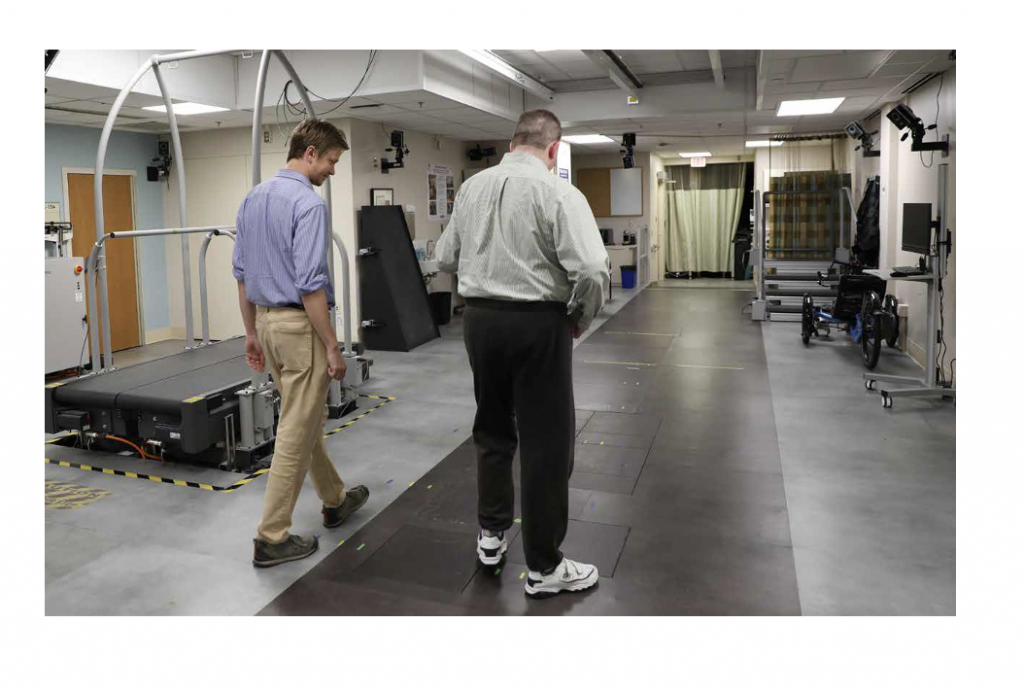
Now, it was time to gather data while using the standing system that includes the oscillation patterns. In the lab, there are a set of parallel bars and force plates on the floor. Both are wired to collect data while standing to evaluate the weight distribution between my arms and my legs. The test method consists of standing with the oscillation pattern for one minute or until the legs fatigue; whichever is longer. With the therapist guarding my knees and the engineer holding the external control unit with the experimental patterns, I stand inside the parallel bars. Each stand was only for just about a minute, but long enough to gather the data the research team needs.

Back to the drawing board to understand how the cuff electrodes used in the standing system can be optimized for my particular nerves and muscles. The research team needs more time and information to continue to explore this new concept. It's an incremental learning process that requires patience and the ability to deal with unexpected results. That's the nature of research. It's important to remember that we learn something new that moves us forward with every experiment regardless of the outcome.


Paying the Consequences

June 27, 2011

After returning from the UK, I was pretty excited about my real world experiences with the new patterns programmed into the system. The Wheelchair Propulsion pattern made it easier to wheel between the condo and the sailing venue. The Glut Shift pattern helped reduce the pressure while sitting in an airline seat for nearly 8 hours. And the Trunk Control pattern aided my daily functions in a condo that was not quite wheelchair accessible.

That is all great. But each of those patterns excludes one important muscle group, the quadriceps. I failed to recognize it earlier and after returning home, I paid the consequences. This issue did not surface until I was back home and returned to standing with the crutches.

You see, during competition and even the few days leading into it, there is not much time for activities away from sailing. We typically spend five hours on the water with at least one hour on either end for boat work; add on weather briefings, coach's reviews, an occasional protest, dinner, a shower and I'm done for the day. The exception is a weather delay; and we all know how reliable that is! In fact, I've been caught sleeping and exercising with the system after being on the water all day. Unfortunately, there is not much time for anything else.

Read more: Paying the Consequences


Page 1 of 6


In the News

January 2, 2012

Buckeye Wellness Center Crucial Fitness Resource for People with Spinal Cord Injuries

Buckeye Wellness Center Crucial Fitness Resource for People with Spinal Cord Injuries

VALLEY VIEW, Ohio -- Exercise bikes, an unweighted treadmill, a seated stepper and other workout machines fill the newly carpeted room at Buckeye Wellness Center in Valley View. But this is far from a typical fitness center.

More

December 31, 2011

Bill Memberg Adapts Toys for Kids with Special Needs: Community Heroes 2011

Bill Memberg Adapts Toys for Kids with Special Needs: Community Heroes 2011

To show what he does in his spare time, when he's not helping people with spinal cord injuries to move their arms and legs, Bill Memberg pulls a fluffy red Elmo out of a gym bag and plops it on a table in a cafe at MetroHealth Medical Center.

More

November 28, 2011

Brain Probe that Softens After Insertion Causes Less Scarring, Researchers Find

Brain Probe that Softens After Insertion Causes Less Scarring, Researchers Find

A hard probe inserted in the cerebral cortex of a rat model turns nearly as pliable as the surrounding gray matter in minutes, and it induces less of the tough scarring that walls off hard probes that do not change, researchers at Case Western Reserve University have found.

More